Accueil du siteDocumentationProgrammation / SoftwareMicrosoft Robotics Studio
Dernière mise à jour :
mardi 30 juin 2009
Statistiques éditoriales :
391 Articles
62 Brèves
70 Sites Web
16 Auteurs

Statistiques des visites :
0 aujourd'hui
0 hier
269730 depuis le début

Brèves
Robot touriste à la Cité des Sciences
samedi 30 mai
Dans la rubrique "j’ai testé pour vous", voici une petite présentation du contrôle d’un robot à distance : moi dans mon fauteuil dans le sud de la France et le robot à la Cité des (...)
 
Petit module intéressant
vendredi 17 octobre
Eric a déniché cette carte de développement intégrant un microprocesseur puissant : kit rabbit chez Matlog Surtout quand on voit son prix, et celui de l’offre de lancement (25 € HT) (...)
 
Environnement de dev pour arm7
samedi 24 novembre
Bonjour à tous, J’attire votre attention sur ceci : kit arm7 iF-Dev kit iSystem Arm7 carte Arm7 iSystem (...)
 
Sur le Web
Domotics | Immotique
L’auteur vous fait partager son projet de domotique. Il met en page ses expériences sous forme d’articles. Des scripts sont proposés en téléchargement. Un forum et un annuaire de liens vous proposent des mises à jour fréquentes
Capteurs Mindsensors

Des capteurs et des compléments pour enrichir la brique Lego NXT de nouveaux équipements.

Vous trouverez des caméras, des capteurs de distance, des cables et des connecteurs compatibles avec RCX, ainsi que des cartes de développement en numérique et désormais en analogique !

I2C Chip I2C & SMBUS, Slave IC’s, Host Adaptors, RS232 / USB adaptors 2-wire bus
I2C/SPI Host Adaptors, Chips, and Modules. PC to I2C/SPI 1wire. USB and RS232 Interface
MRS Example : Show me a picture when you see a fire
mardi 10 octobre 2006
par Chris
popularité : 1%
This examples shows how to use a TPA81 passive infra red sensor to detect a fire and then tell the user and show a picture of the fire using the Visual Programing Language.

This examples uses a tool called Visual Programing Language which is a part of MRS and lets you program using drag and drop, a bit like the Lego program bricks.

You may laugh at such a tool, but it can be an effective way of quickly combining services to test a strategy, and opens up the use of MRS to those who do not want to spend a month getting their head around the ccr, generics, iterators and service architectures.

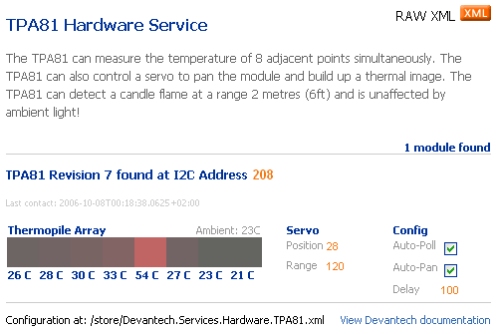
The TPA81 Thermopile Array (View Documentation) can test the temperature of 8 pixels and control a servo to allow panning of the sensor.

The default configuration is shown below :

Here it is set up to update and store each pixel’s temperature and move the servo with a 100 milisecond gap between each poll.

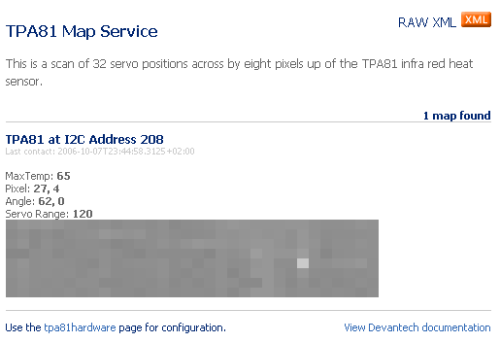
We could use the TPA81Map service to show us exactly where the hot spot is :

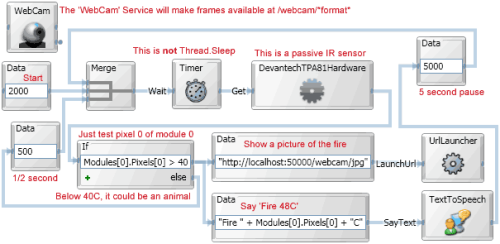
But in this example, we will just use the TPA81 Hardware service by dragging it into the Visual Programing Language window and making the following program :

This simple program starts by a 2 second wait, then does a ’Get’ of the sensor service every half a second. Note that the TPA81 is itself polling the device every 100 milliseconds, so we could have made this polling much faster. Indeed a more elegant aproach would have been to subscribe to the TPA81 to get notifications of each sensor change.

If the temperature of pixel zero of module zero is above 40C, it will send some text to the Text-To-Speech service to say ’Fire 48C’, and launch a browser url to show the latest picture available from the webcam service. After this it does a 5 second pause, so as not to flood your browser too much.
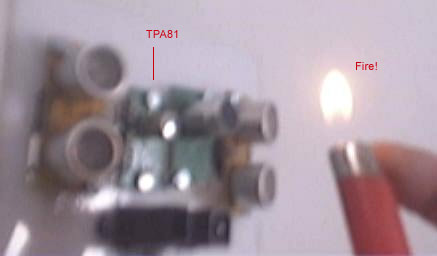
This very simple program is unlikely to win you any competitions, but gives you the idea of ways in which tools like the Visual Programing Language can open up robotics programing to newcomers who want results fast - All power to them, I say.

Chris Kilner


Répondre à cet article
This section's articles
  1. Microsoft Robotics Studio (VO)
    9 October 2006

  2. Microsoft Robotics Studio (VF)
    15 novembre 2006

  3. MRS Example : Show me a picture when you see a fire
    10 octobre 2006